

From an idea to PEAT-GENIE: the story behind our project
27.10.2026
About two years ago, PEAT-GENIE was just an idea I was discussing with a few colleagues at the Geological Survey of Finland (GTK). I couldn’t have imagined that it would eventually grow into a European project bringing together 20 partners from 10 countries.
Having worked on several AI-related projects, I wanted to do something a little different. Instead of asking, “What can AI do?”, I was more interested in how we could turn the enormous amounts of environmental data and increasingly advanced models into something people could actually use when making decisions.
My idea was to combine AI, Generative AI, and Digital Twins to make this possible. But where could we apply these technologies to make a real difference?
I still remember my early discussions with my colleague Tinja. I had an idea but wasn’t sure how to turn it into a Horizon Europe proposal. Tinja was one of the first people who believed in me and encouraged me to take on the challenge. Her support gave me the confidence to move forward.
Around that time, I had been involved in an internal GTK project called MaaTi, working with peatland-related data. I had become familiar with the importance of peatlands for carbon storage, biodiversity, and water management, as well as the challenges involved in managing them. With GTK’s strong peatland expertise and valuable datasets, focusing on peatlands seemed like a natural choice. I also liked the idea of contributing to the protection and restoration of these ecosystems.
But turning the idea into a Horizon Europe project was another challenge!
I started by contacting researchers I had worked with before. We already knew each other and how to work together. As discussions continued, they introduced me to other researchers and organizations, and gradually, the consortium took shape.
Bringing together people from different scientific backgrounds wasn’t always easy. Everyone had their own ideas, and we spent a lot of time discussing and refining the project. For example, we initially focused on land-cover mapping and greenhouse gas emissions but later expanded the scope to include biodiversity and hydrology.
Another important decision was to involve end users from the beginning. I had seen research projects where tools were developed first and users were only asked at the end whether they were useful. I wanted PEAT-GENIE to take a different approach. That’s why we invited organizations working directly with peatland management and restoration to join the consortium during the proposal preparation.
About five months before the deadline, we started writing the proposal. I still remember those days in July. Many of my colleagues were enjoying their summer holidays, the weather was beautiful, and there I was, sitting in my office working on the proposal instead of enjoying the Finnish summer!
Fortunately, starting early paid off. We had a complete draft ready a month before the deadline, giving our research support team time to review it several times and helping us improve the proposal before submission.
Then came the waiting.
When I heard that PEAT-GENIE had been selected for funding, I was incredibly happy and relieved. I remember thinking, “Wow, this is really happening!” I was proud of what we had achieved together, but also a little nervous about the responsibility ahead.
Looking back, I realize how much this experience taught me about teamwork, patience, and the importance of having people who believe in you.
Today, seeing our partners working together, I sometimes think back to those first discussions at GTK. There are still many challenges ahead, but I’m happy that our idea has become a project we can now develop together.
And if I could share one lesson from this experience, especially with early-career researchers and women who might hesitate to take on a coordinator role, it would be this: don’t wait until you feel completely ready. Believe in yourself and give it a try. You don’t need to have all the answers at the beginning.
Fahimeh Farahnakian
Senior Researcher
PEAT-GENIE’s Scientific Lead at the Geological Survey of Finland (GTK)
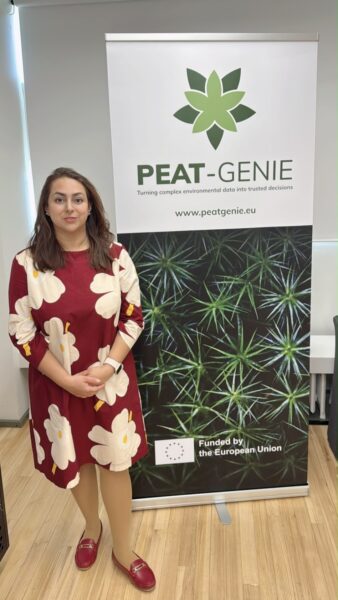
Fahimeh Farahnakian, Senior Researcher and PEAT-GENIE’s Scientific Lead at the GTK